Starfield Advisory — Hosted by Ololade Oloniyo

SA Entrepreneurship Series

The SA Entrepreneurship Series is a live, online forum curated and hosted by Ololade Oloniyo of Starfield Advisory — bringing together founders, investors and advisors to unpack the practical realities of building and scaling a business across borders. Insights. Strategies. Growth.

SA Entrepreneurship Series — Series #2

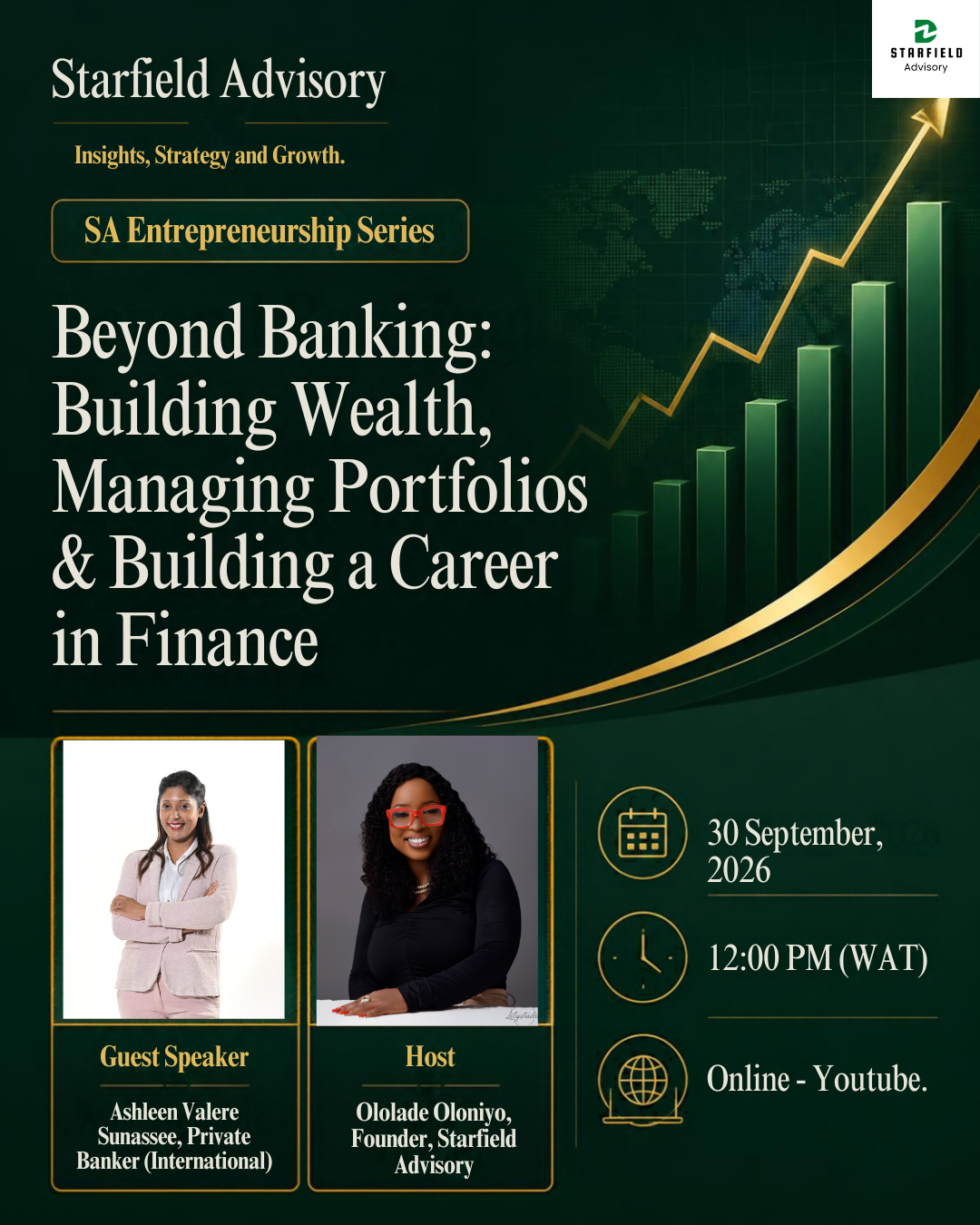
Beyond Banking: Building Wealth, Managing Portfolios & Building a Career in Finance

SA Entrepreneurship Series #2 flyer — Beyond Banking, with guest speaker Ashleen Valere Sunassee and host Ololade Oloniyo, 30 September 2026

See full video here — https://www.youtube.com/watch?v=I_0CE1aeAQQ&t=158s

Series #2 — Guest speaker Ashleen Valere Sunassee, Private Banker (International), and host Ololade Oloniyo, Founder, Starfield Advisory. 30 September 2026.

Session Notes — Series #2

Conversation with Ashleen, Private Banker at Mauritius Commercial Bank (MCB)

Understanding Wealth Management

Ashleen began by reflecting on her professional journey, explaining that she started her career at the age of 18 and joined Mauritius Commercial Bank (MCB), where she has gained extensive experience and steadily progressed in her career.

She described wealth management as the process of making money work, grow, and remain protected over time. This distinction is particularly important in the African context, where inflation and currency depreciation can significantly erode the value of money. Leaving money in a traditional savings account may provide security and liquidity, but it may not necessarily preserve its purchasing power over time. The goal, therefore, is to move beyond simply accumulating money towards building sustainable wealth through strategic investments and effective financial planning.
Transitioning from Saving to Investing

The transition from saving to investing is not necessarily about having a large amount of money to begin with. It is about starting with what one has, investing consistently, and allowing disciplined financial decisions to compound over time.

What Is Portfolio Management?

Portfolio management involves strategically selecting, allocating, monitoring, and adjusting investments to meet an individual's financial objectives.

Key considerations in portfolio management include:

  • Asset allocation: Determining how investments should be distributed across different asset classes.
  • Diversification: Spreading investments across different assets, sectors, industries, and markets to manage concentration risk.
  • Liquidity: Assessing how quickly an investment can be converted into cash without significant loss of value.
  • Monitoring and rebalancing: Regularly reviewing portfolio performance and adjusting allocations as market conditions and the client's financial goals evolve.

Ashleen stressed that portfolio management is not a one-off exercise. It is an ongoing process that requires continuous monitoring, periodic reassessment, and strategic adjustments as new investment opportunities emerge and market conditions change.

How Can Professionals Build Wealth?

For entrepreneurs, this is particularly important because a significant proportion of their net worth may be tied to their businesses. While a successful business can generate substantial wealth, excessive concentration in a single venture exposes the owner to considerable financial risk. Professionals and entrepreneurs should therefore consider building assets beyond their primary source of income, investing gradually, and developing a long-term financial plan.

Building wealth takes time, and preserving it across generations requires even greater discipline, foresight, and planning.

The key message is simple: one does not need to wait until they have accumulated substantial wealth before beginning to invest. Starting early, investing consistently, and making informed decisions can lay the foundation for long-term financial security.

Wealth Preservation and Intergenerational Wealth

Wealth preservation involves protecting accumulated assets against risks that could diminish their value and ensuring that they remain sustainable over time. Ashleen highlighted the importance of entrepreneurs thinking beyond wealth creation to consider how their assets can be structured to protect their interests, support their families, and facilitate the transfer of wealth across generations.

Successful entrepreneurs should ask important questions, such as:

  • Should I establish a trust to protect and manage my assets?
  • Should I hold certain assets in my personal name or through an appropriate legal entity?
  • How can I structure my wealth to protect my family and support future generations?
  • What arrangements should I put in place to ensure the continuity of my wealth?

The appropriate structure will depend on an individual's circumstances, objectives, jurisdiction, tax position, and legal obligations. Professional advice is therefore essential when making these decisions.

Ashleen also highlighted the role of family offices in wealth preservation. Family offices help wealthy individuals and families coordinate financial planning, investment management, diversification, succession planning, and other services designed to protect and sustain family wealth.

The broader lesson is that building wealth is only one part of the journey. Protecting it, managing it effectively, and preparing for its transfer to future generations are equally important.

Women and Wealth Building

Ashleen observed that women sometimes hesitate to ask for financial opportunities, including stock options, equity participation, and other benefits that could significantly contribute to their long-term wealth.

She encouraged women to become more intentional and confident about their financial futures by taking ownership of their earning potential and actively participating in wealth-building opportunities.

Her recommendations included:

  • Pay yourself first: Treat saving and investing as essential financial commitments rather than activities left to whatever money remains at the end of the month.
  • Automate your investments: Set up automatic transfers into savings and investment accounts to build consistency and discipline.
  • Negotiate for equity: Where appropriate, ask about stock options, share ownership, and other opportunities to participate in the growth of the organisations you work for.
  • Invest beyond your salary: Build assets that are independent of your employment income.
  • Think long term: Focus on sustainable wealth accumulation rather than short-term financial gains.

Understanding Investment Diversification

Investment diversification is the practice of spreading investments across different asset classes, industries, geographical markets, and financial instruments to reduce excessive exposure to any single source of risk.

A diversified portfolio may include exposure to equities, fixed-income securities, commodities, and international markets, depending on the investor's financial goals, risk tolerance, and investment horizon.

Diversification is particularly relevant for professionals whose income, employee benefits, and investments are already closely tied to a single employer or industry.The objective is to build a portfolio that can withstand changing market conditions rather than depend entirely on the continued success of one company, sector, or asset.

Investment Opportunities for Nigerians and West Africans

Ashleen highlighted the importance of looking beyond domestic markets when building a diversified investment portfolio.

For Nigerian and West African investors, international investing can provide access to global companies, industries, and financial instruments that may not be readily available in domestic markets.

She encouraged investors to stay informed about market trends, economic developments, company performance, and relevant financial data to make better-informed investment decisions.

The key is not simply to follow investment trends or invest in companies receiving widespread attention. It is to understand the underlying investment, assess its suitability, and ensure that it aligns with one's broader financial objectives.

Managing Foreign Exchange Risks

She also discussed the importance of responding strategically to currency movements, including considering opportunities to buy or sell currencies depending on prevailing conditions.

However, foreign exchange decisions should be based on individual cash-flow requirements, currency exposure, and an informed assessment of market conditions rather than attempting to predict every market movement.

A sound approach to managing foreign exchange risk includes:

  • Maintaining an adequate emergency reserve.
  • Matching income and expenses to the currencies in which obligations are denominated, where practical.
  • Diversifying currency exposure where appropriate.
  • Monitoring economic developments and exchange-rate movements.
  • Avoiding speculative decisions based solely on short-term currency fluctuations.

The objective is to protect purchasing power, maintain financial flexibility, and reduce the impact of adverse currency movements on long-term financial plans.

Building a Sustainable and Successful Career in Finance

Drawing from her professional experience, Ashleen identified several values and competencies that are essential for building a sustainable career in finance and wealth management.

  • Trust and discretion
  • Active listening
  • Relationship management
  • Mentorship
  • Ethics and integrity
  • Continuous learning

The Future of Finance: Technology and Artificial Intelligence

Ashleen discussed the growing role of technology and artificial intelligence in the financial services industry.AI is increasingly useful in areas such as compliance monitoring, fraud detection, data analysis, risk assessment, and portfolio research. Technology also enables wealth managers to access relevant data, monitor portfolios, and identify investment opportunities more effectively.However, it should be noted that technology cannot fully replace the human relationships at the heart of wealth management.

Successful entrepreneurs and high-net-worth individuals often require more than technical investment recommendations. They need advisers who understand their personal circumstances, business interests, ambitions, and family priorities. A trusted adviser brings context, emotional intelligence, professional judgment, and an understanding of the relationship built with the client over time.

The future of finance, therefore, lies in combining technological innovation with human expertise. AI can enhance the quality and efficiency of financial advice, but trust, empathy, and sound judgment will remain essential to effective wealth management.

Conclusion: From Earning Income to Building Generational Wealth

For professionals, entrepreneurs, and individuals seeking financial independence, the priorities are to invest consistently, diversify wisely, protect accumulated assets, and prepare for the future.

For those who aspire to build generational wealth, the process also involves putting appropriate legal and financial structures in place to preserve assets and facilitate the transfer of wealth across generations.

Her message can be summarised in three principles:

  • Start small: You do not need to be wealthy to begin investing.
  • Start with discipline: Make saving and investing consistent financial commitments.
  • Start with a plan: Build a strategy that considers your financial goals, risk tolerance, wealth preservation, and long-term legacy.

Ultimately, wealth is not simply about how much money you earn. It is about how effectively you manage it, the assets you build, the risks you prepare for, and the legacy you leave behind.

SA Entrepreneurship Series — Series #1

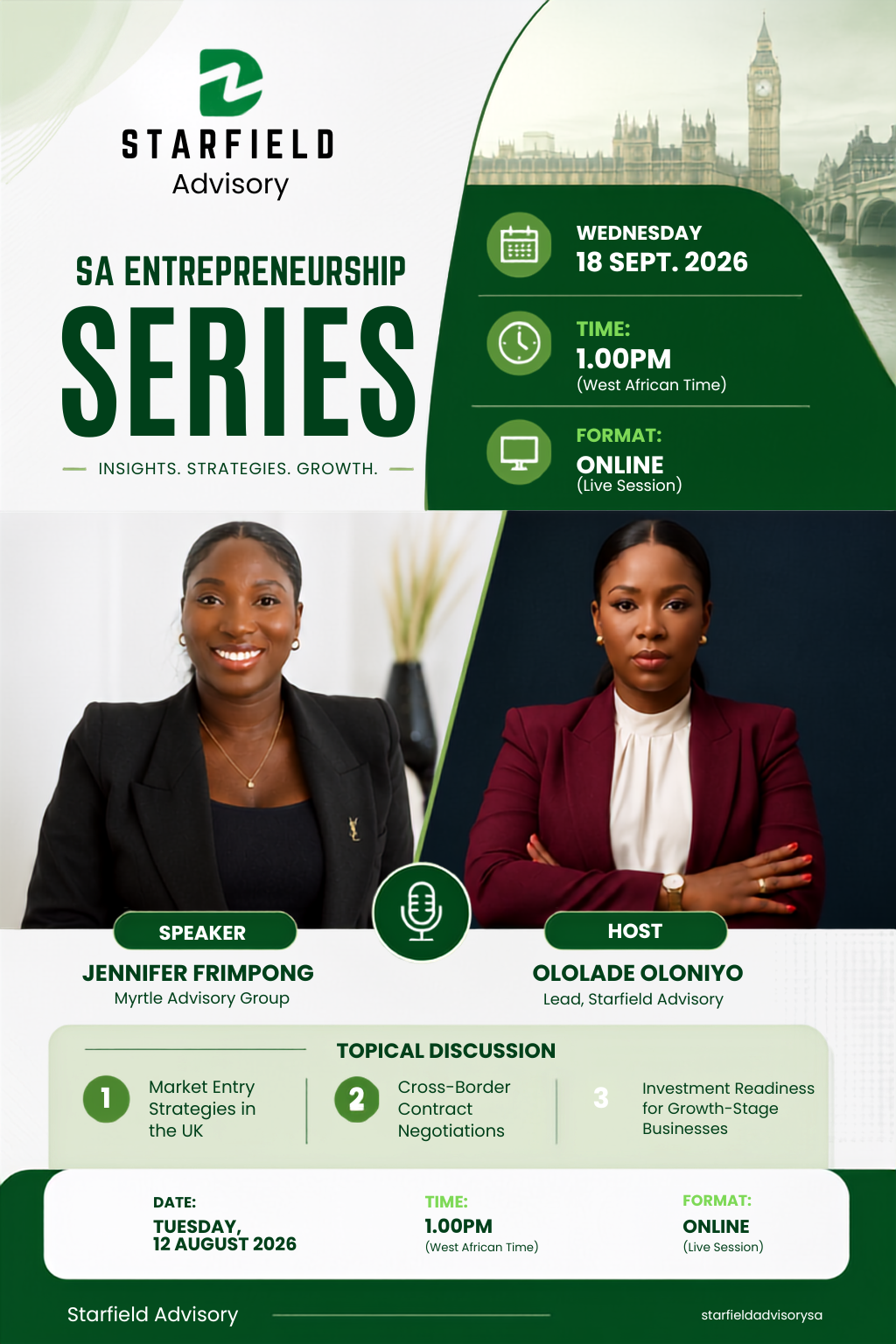
SA Entrepreneurship Series #1 flyer — Speaker Jennifer Frimpong (Myrtle Advisory Group) and Host Ololade Oloniyo (Lead, Starfield Advisory)
Series #1 — Speaker Jennifer Frimpong (Myrtle Advisory Group), Host Ololade Oloniyo (Lead, Starfield Advisory). Live online session.

See full video here — https://www.youtube.com/watch?v=06tTz-jDXaA&t=784s

Session Notes — Series #1

International Market Expansion, Compliance & Investment Readiness

Introduction: Expanding beyond your home market

Expanding a business into an international market requires more than having a good product or identifying a promising opportunity. Entrepreneurs need to determine whether the market is viable and whether the business itself is ready to expand.

This involves:

  1. Understanding the market-entry model.
  2. Assessing operational capacity.
  3. Validating customer demand and considering whether working with an established distributor or local partner would provide better access to the market.

Expansion should be evidence-led rather than driven by assumptions, as entering a market without the right structure, resources, or knowledge can increase the risk of failure.

Compliance and governance

Compliance should be considered before entering a new market, not as an afterthought. Entrepreneurs must understand the regulatory requirements affecting their industry, including data protection, taxation, employment and labour laws, immigration, and corporate governance. The specific requirements will depend on the country and sector in which the business operates.

Even after registration, businesses must continue to meet reporting and governance obligations. A strong operational structure, good governance, and proper compliance systems are therefore essential to sustainable international expansion.

Contracts, intellectual property and risk

Founders and investors should also pay close attention to the legal and commercial terms of their business relationships. Before signing a contract, founders should consider not only how they will enter a deal but also how they can exit it. Key issues include termination, governing law, dispute resolution, currency and foreign exchange exposure, liabilities, indemnities, and intellectual property ownership.

IP is particularly important in creative, technology, and consulting businesses, where ownership can become complicated when working with larger organisations or when founders separate. Getting appropriate legal advice can help identify risks and ensure that responsibilities and ownership are clearly defined.

Investment readiness and relationships

Commercial success does not automatically guarantee investment, as a business may not fit a particular investor's strategy, or may need stronger evidence of scalability and traction.

Key tips

  • —Investment readiness should be treated as an ongoing management discipline rather than something that begins when funding is urgently needed.
  • —Network intentionally and build genuine relationships with investors, industry leaders, partners, and customers.
  • —Social media can further help founders communicate their expertise and build visibility, while diaspora communities can provide valuable market knowledge, credibility, connections, and access to international markets.

Conclusion

The key lesson is that successful international expansion depends on strategy, preparation, compliance, governance, relationships, and good decision-making.

Entrepreneurs should understand the market before entering it, build the necessary systems before scaling, protect their interests through well-structured contracts, and continuously prepare the business for investment opportunities.

Most importantly, founders should not wait for an opportunity before becoming ready; they should build a strong and investment-ready business so that when the right opportunity comes, they are prepared to take advantage of it.

Looking to sharpen your own market-entry or investment readiness strategy? Explore Ololade's speaking and advisory work.